 NukeSimulation.com
Named weapon
B83 blast radius (1.2 Mt)
Last updated
B83 is listed here as the largest US bomb still in the arsenal, at 1.2 Mt. That is eighty Little Boys of yield and about four times Little Boy’s blast radius in this scaling.
Educational estimate only. Blast and heat rings use simplified yield scaling. They ignore terrain, weather, shielding, and weapon design. Casualty counts use WorldPop 2020 residents on an approximately 1 km grid and ignore time of day, commuting, shelter, and evacuation. This is not a targeting or civil-defense tool. About the model.
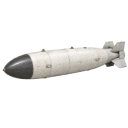
| Effect | Ground range | What the model means |
|---|---|---|
| Fireball | 1.5 km (5,034 ft) | Maximum luminous radius |
| 20 psi | 3.6 km (2.2 mi) | Heavy destruction |
| 5 psi | 7.8 km (4.9 mi) | Most buildings collapse |
| Thermal | 12.3 km (7.7 mi) | 3rd-degree burns |
| 1 psi | 18.1 km (11.2 mi) | Windows shatter |
Megaton gravity bombs are a different era of delivery than Trident warheads, but the globe only cares about yield and burst height.
Moruroa uses B83 as a large analog for French Pacific testing because this list has no Canopus preset. The atoll page labels that as an analog.
For US megaton tests, Ivy Mike and Castle Bravo are the historic shots; B41 is the larger retired bomb class.
See this yield on a place
Moruroa · New York · Los Angeles · London
Other weapons
Little Boy · Fat Man · W76-2 · W76-1 · W87 · W88 · B83 · B53 · Ivy Mike · Castle Bravo · B41 · Tsar Bomba
Open the simulator · How the numbers work · FAQ · Privacy · Terms · support@nukesimulation.com